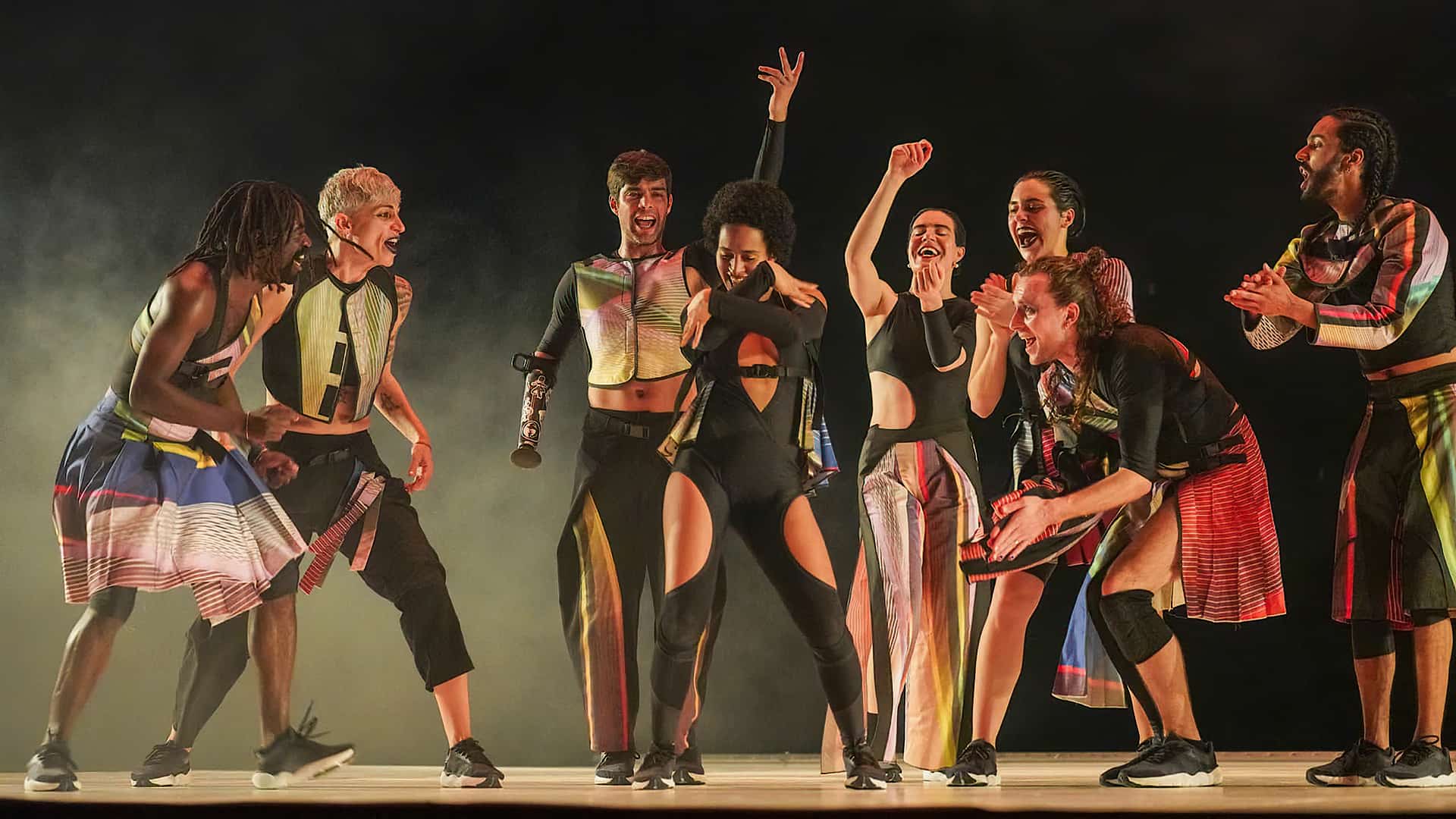
"I've never seen anything like it!" The words of my astonished companion after the 75 minutes of raw, visceral energy that is Carcaça. What had we seen, felt, experienced? Dance, theatre sport, physical theatre; a maelstrom of human emotion made manifest in the jagged, violent movements of nine dancers who moved seamlessly between group frenzy and individual agony.
The agony and the ecstasy! Indeed, there was something Michaelangelesque about the way the dancers' bodies seemed to emerge from sculpture, like Michaelangelo's slaves breaking out of their marble, with contortions deriving from a vital re-imagining of the classical "contrapposto".
There was no program to this show, nothing to mediate the space between the rawness of the performance and the audience's unfiltered reception. There were only a few remarks from the Portuguese director, Marco da Silva Ferreira, indicating that the movements of his dancers emerged from clubbing, street dancing, and European folk dances. These latter at their wildest – the Sicilian tarantella, Cossack dancing, Greek group dancing in a rare moment where the dancers touched each other.
Yet early on, the dancers seemed to express the inner world of drug-induced hallucinations, and I was reminded of descriptions (I have never been present at a ceremony) of Brazilian Candomblè, that remarkable fusion of African, native American and Catholic rituals.
The dancers were dressed in clothes which combined harlequin rags, deliberately torn jeans, and leotards with great holes in them, these holes exposing random bits of naked body. This was all part of the rawness of the experience, and contributed to the atavistic nature of the show as it careened between ritual and chaos.
The stagecraft of the performers was magnificent. They used the space in all kinds of configurations, from choreographed to improvised patterns, from ensembles of various sizes to solo spots, from chorus clusters in one corner of the stage to rushing to fill the empty spaces. In the solo spots the other 8 dancers sometimes formed an audience variously admiring or jeering. These solos were also opportunities to express the individuality of each dancer, individuality which was most of the time subsumed into the group. Thus the blackness of the one black dancer became conscious as a matrix of racist rejection; the prosthetic forearm of another dancer was detached at one point and used as a weapon, a megaphone, and a police torch: and the eroticism of a coloured woman exteriorised as a metaphor for our Western culture's deep fear of sex.
There were political messages. A Portuguese folksong about the oppression of women workers was sung with raw vigour by the dancers, symbolised by some dancers using part of their costume to conceal their faces, suppressing their identity. At the climax of the show this single, forcefully rhyming message was written on the upended stage floor: All walls fall.
Ah, and the music. The show started with a single percussionist with a not very elaborate drum kit, stationed in front and to the side of the stage. He played complex patterns, intimately connected with the visceral, jerky movements of the first dancer. When the other dancers joined in, one by one, the other musician added a skein of computer generated sound. Complex rhythms were draped over a predominantly triple metre, and, without wishing to sound like Bruno Heinz Jaja, this triple metre connected the stage choreography more to folk dance, than to the deadeningly relentless 4/4 metre of clubbing music. After perhaps 20 minutes, both musicians stopped playing, and we suddenly became aware of the percussive nature of the sound of dancers’ sneakers on the stage mat. Then the dancers began to sing the folksong material I have already mentioned, which also imbued the electronic music when this re-emerged into the musical tissue.
After the All walls fall moment the performance ended with a dystopian scene shrouded in orange smoke, which had resonances of prison yards and tear-gas. The sweat generated by the intense energy of every scene now glistened on all their half naked bodies, embodying the stories the dancers were telling..
Da Silva Ferreira asks in his show notes “What do we want to preserve, what do we want to transform, and what do we want to forget?” The extraordinary vigour and vibrancy of this show is perhaps best thought of as the necessary forge in which to unfreeze the folk traditions of the past and bring them into conversations with the urban practices of the present.
I have never seen anything like it.
Event details
2025 Perth Festival
Carcaça
Choreographer Marco da Silva Ferreira
Venue: Heath Ledger Theatre | State Theatre Centre of WA, 174 William St, Perth WA
Dates: 7 – 9 February 2-25
Tickets: $59 – $79
Bookings: www.perthfestival.com.au
.jpg)